Welcome to Rotary District 5050!


Spanning communities in southwestern British Columbia and northwestern Washington, Rotary District 5050 is 50% American, 50% Canadian, and 100% Rotarian. We bring people together to take action, build friendships, and create lasting change — locally and around the world. Whether you're curious about Rotary or already part of our network, there's a place for you here to grow, lead, and make a difference.

Governor's Message - April 2026

April, Rotary’s Environmental Month, calls Rotarians to reflect on climate action and the shared responsibility to protect and restore our environment. Across District 5050, from Washington to British Columbia, communities are united by both landscape and purpose. Despite challenges like flooding and global uncertainty, Rotarians continue to lead through meaningful initiatives, including habitat restoration, sustainable practices, and emergency response. The Climate Change Action Group exemplifies this impact through education, local engagement, and international projects. Youth programs and individual lifestyle changes further strengthen efforts. Together, these actions demonstrate how collective leadership and everyday choices can create lasting, positive environmental change real.

Read more to explore ideas and get involved.


Featured Events

District 5050 News & Stories
Feb. 01, 2026

What Does Peacebuilding and Conflict Prevention Look Like?

February invites us to reflect on one of Rotary’s enduring commitments: building peace in our communities and mitigating conflict in the world. Through peacebuilding and conflict prevention, understanding, dignity, opportunity, and hope are cultivated. This work is achieved through patience, relationship-building, dialogue, and service that lifts people up and brings communities together. In Rotary, peacebuilding and conflict prevention are strategies that benefit everyone.

As Rotarians, we are positioned to be peacebuilders by the very nature of what brings us together. Our Clubs embrace people of different backgrounds, cultures, professions, and perspectives. In a world that can feel increasingly divided, Rotary reminds us that differences are not barriers. Instead, those differences are strengths when we embrace them with respect and curiosity. Every time we listen with empathy, collaborate across viewpoints, or serve alongside someone who sees the world differently, we are practicing peace in action.

Rotary’s global commitment to peace is equally powerful. On 14 March 2026, a Rotary Forum on the Future of International Organizations will be held at the United Nations Educational, Scientific and Cultural Organization (UNESCO) Headquarters. This is an exceptional and rare opportunity to experience leaders from around the world collaborating and reflecting on major global issues, producing a white paper that will be submitted to UNESCO, the World Health Organization (WHO), and UNICEF with the purpose of inspiring action. Click this to discover the Forum and registration details.

Since World War II, Rotary International has been a key participant in the formation and development of the United Nations (UN) and has maintained a strong partnership dedicated to promoting peace and addressing global humanitarian issues. Through the Rotary Representative Network, Rotary members serve as liaisons with humanitarian organizations that share a mission of peace and development. Rotary was also instrumental in the creation of the Universal Declaration of Human Rights, signed at the Palais de Chaillot in 1948. Rotary remains one of the most respected nongovernmental organizations in the world.

Through our Rotary Peace Centers, we invest in leaders who are trained to prevent and resolve conflict, support post-conflict healing, and build sustainable peace throughout the world. Rotary Peace Fellows carry our values into governments, NGOs, schools, and communities worldwide, extending the impact of our service far beyond district and national borders. At this moment, we have over 1,700 Peace Fellows around the world sharing their knowledge and skills to support communities. Now is the time to nominate a Peace Fellow. For more information, please contact PDG Brad Whittaker or at 604-819-6402.

Along with global grant projects throughout the world, important work is being led by Rotary Club of Burlington, Rtn. Bernie Halliday, who serves as International Project Alliance (IPA) President and Chair, transforming lives in areas such as Copan, Honduras (info@ipafounda/on.org) and Intercountry Committees (ICCs) working in Belize under the leadership of Rotary Club of Port Moody, Rtn Al Stjernegaard (https://rotary-icc.org/) United through purpose, Rotarians actively shape a better world.

Peacebuilding also shows up at the Club level when we address food insecurity, support mental health initiatives, support global peace ambassadors, welcome newcomers, mentor youth, or create safe spaces for conversation. Although these efforts may not always be labeled as “peace projects,” they prevent conflict by strengthening trust, reducing inequity, sharing critical resources, and fostering belonging. When people feel seen, supported, and valued, communities become more resilient.

Rotary leads by example and supports the efforts of peacebuilders at home. I reflect on the impact of our Ambassadorial Scholar, Dr. Yashar Keramati, a brilliant surgeon who flew to Cuba on 21 January on a humanitarian mission to provide emergency medical assistance. In February, he will fly to Mexico, where he will volunteer in trauma surgery units at Culiacán General Hospital. He brought with him over 400 pounds of medical supplies donated by Rotarians in our District. I urge you to connect with him as a speaker, inspire support for his efforts through personal contacts, supplies, or donations, and read more about his work at: https://portal.clubrunner.ca/1355/stories/yasha-keramati

The Rotary Club of Aldergrove, led by President Robin McIntosh, will welcome incoming President Jessica Harris for the 2026–2027 year. Jessica’s Rotary journey began in 1992 as a Rotary Youth Exchange student in Brazil. That experience led to a deeper relationship with Rotary, including her becoming an Ambassadorial Scholar in 2002, which led her to work throughout the world in peacebuilding and conflict prevention in vulnerable and conflict-ridden areas. Jessica contributed her story to the November issue of the Peace Arch Journal. If your Club wants to understand firsthand the impact of becoming a Peace Fellow, please reach out to Jessica.

On a personal level, I often speak about the importance of our Rotary family. I recognize that, in any family, we have differing points of view that can sometimes cause division, disruption, or difficult conversations. In moments of disagreement, within our Clubs, workplaces, families, or communities, we have the opportunity to choose thoughtful dialogue over division, compassion over criticism, and collaboration over conflict.  We can choose a thoughtful response  rather than simply reacting. These choices may seem small, but collectively they shape a culture of respect and understanding.  They contribute to who we are as Rotarians.

This month, I encourage every Club to reflect on how peacebuilding is woven into your service and to consider how you might deepen that impact. Host a conversation on conflict resolution, partner with organizations or individuals supporting peacebuilding, conflict resolution, youth leadership, or highlight stories of peacebuilders within your community. Even a single act of kindness can be a powerful shift away from conflict.

Peace is built through consistent, caring action, through one relationship, one project, one conversation at a time. Thank you for being Rotarians who choose peace, who lead with heart, skill, and thoughtful action, and who believe that a more understanding and compassionate world is possible.

With gratitude for your service,


Feb. 01, 2026

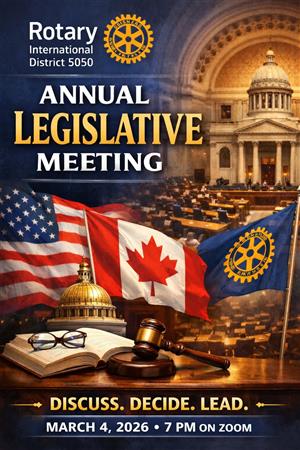
The Rotary International Council on Legislation has eliminated the requirement for an annual District Conference business meeting, replacing it with a District Legislative Meeting. A committee led by IPDG Dave Duskin reviewed and updated the District Leadership Plan and Policies. The District Legislative Meeting will be held virtually on March 4, 2026, at 7:00 PM via Zoom. Club Presidents, Secretaries, or authorized representatives must register by March 2. Agenda items include amendments to the District Policy Manual, approval of the revised Leadership Plan, approval of 2024–2025 financial reports, and other submitted resolutions, along with updates on District activities. Please join between 6:30 and 6:55 so that the meeting can start on time. Late arrivals may not be admitted.

Jan. 01, 2026

Honouring Every Path – Why Every Vocation Matters

Vocational Service Month is a powerful reminder that every vocation matters. Across District 5050, Clubs create meaningful opportunities for Rotarians to share their vocational journeys, the passion, purpose, or circumstances that led them to the work they have done throughout their lives. These stories deepen our understanding of one another, broaden our perspective, and foster a genuine appreciation for work we may never have personally experienced. Most importantly, they allow us to see the value of every profession through a deeply personal lens.

Vocational Service is not about titles or accolades. It is about integrity. It is reflected in the daily choices we make, the way we treat others, and the values we carry into our workplaces and communities. As Rotarians, our vocations are more than what we do, they are an expression of how we live our commitment to Service Above Self.

Within our District, Rotarians represent an extraordinary range of professions. Each one matters. Each brings unique skills, perspectives, and lived experiences that shape who we are and how we show up in Rotary. When we honour all vocations, we honour the people behind them, and the impact they make, often quietly and without recognition.

My own vocational journey began at a very young age, working in every aspect of my family’s restaurant business. The service industry is demanding, physically, mentally, and emotionally. It requires resilience, humility, and an unwavering commitment to customer service. As a child, working was not a choice; it was a responsibility. I learned to contribute, to endure, and to help strengthen my family through hard work. From washing dishes and cleaning bathrooms to serving customers, bartending, cooking, and managing finances, each role, challenging as it sometimes was, shaped the person I am today. Those experiences grounded me in a deep respect for the work others do and instilled a strong work ethic that continues to guide me. It remains a humbling and formative chapter of my life.

Vocational Service also reminds us of our responsibility to support the next generation. It lives in mentorship, guidance offered to young professionals, support for community organizations, and in moments when we choose to apply the Four-Way Test, especially when it would be easier not to. These actions may not always be visible, but they are profoundly impactful. Through mentorship, scholarships, vocational training, Rotaract, Interact, Rotary Youth Leadership Awards, Youth Engaged in Service, and Youth Adventures in Leadership, we have the privilege of helping young people discover confidence, purpose, skills development, and ethical leadership.

When we share our stories, our successes and our challenges, we help others, especially youth, see what is possible. We show that every job has meaning and that every skill learned can shape a future.

As we begin 2026, I urge each Club to highlight the vocations within your membership. Create opportunities for vocational speakers, storytelling, and mentorship. Celebrate the diversity of skills and experiences around your table. Make space for members to share how their work has shaped who they are and how it strengthens your club’s service.

Thank you for the many ways you live Rotary through your work, your service, and your unwavering commitment to others.


Jan. 01, 2026

Happy Holidays, All

Best of the Holiday Season to all from Team Miss Vicky!

Many have asked how our 1931 Model A is doing after the misfortune of an engine failure. Enroute to Edmonton, Alberta, Canada, last Fall and just 10 miles short of the Canadian border, a brand new (but flawed) piston came apart, leading to a rather abrupt halt to further travel! The good news is that repairs are coming together nicely with the goal of making exhaust just after the Christmas Holiday. After a successful thousand or so break-in miles, we intend to restart the Edmonton Adventure on the 12th of January so that Miss Vicky (and drivers) can attend their first ever hockey game experience at the Oilers Game for PolioPlus on Saturday, January 17th. From there, Fort McMurray, Yellowknife, Harrison Hot Springs, Whitehorse… and Lloydminster(!), are in our sights.

Many folks have also asked: “Why are you tormenting a 94 year old automobile (and yourselves!) with a 700 mile journey to Edmonton in the dead of winter?” The answer for us in the Miss Vicky is simple: just like completing the 10,000 mile Peking-to-Paris Endurance Rally, then rallying 7,500 miles from Anchorage to Cabo San Lucas, we wish to prove that difficult things can be accomplished… even ridding the world of the polio scourge, once and for all.

Winston and I have presented the Miss Vicky Challenge for PolioPlus to many, many Rotary Clubs north and south of our common border. We’ve discovered that fully two thirds of those attending have no, or very limited, appreciation of the forty one year history of Rotary’s signature project known as PolioPlus. The Miss Vicky Challenge and Rotary’s PolioPlus quest is indeed like climbing a mountain: the closer to the summit, the steeper the climb and the closer the possibility (or likelihood?) of failing to achieve the goal. In the twenty five minutes of a typical Rotary presentation, we emphasize the history, some science and the consequences of failing to reach the summit. Therefore, the challenge for Miss Vicky is ultimately to educate, motivate and incentivize fellow Rotarians to continue, step by step, our mutual journey to the summit of a very high mountain: a polio-free world. Join us in January as we restart our journey to “Mount Edmonton” by continuing to contribute generously to The Miss Vicky 2026 Challenge for PolioPlus. This link takes you directly to the Miss Vicky raise.rotary.org website.

Happy Holidays, Lee and Winston


Jan. 01, 2026

Editor's Note: This is the third of a six part series by Marty Pease on how she ended up in Rotary.

International Project Alliance/Honduras

After retiring, Peter Martin sought a way to put his energies into humanitarian service somewhere in Central America. He and his wife were doing a Mayan ruins tour through Central America and stopped in Copán Ruinas, Honduras. He was in a poor Mayan village when a young girl reached up to Peter’s hand and asked, “May I walk with you?” That sparked Peter’s interest, and he started investigating possibilities in that region. He discovered people in need, few active NGOs in the area, and the dollar stretched far. And Copán Ruinas provided comfortable hotels and restaurants for visiting Americans.

His next step was to find an organization that could support his dream. He stumbled onto Rotary, an organization that does service projects and has a grant system to fund them. He joined the Fidalgo Island Rotary Club in Anacortes, Washington. He realized very quickly that what he aspired to accomplish was beyond the capacity of one club. In 2014, five Rotary clubs in Skagit County, including the Rotary Club of La Conner, came together and created the International Project Alliance (IPA).

The program has since grown to fourteen clubs and has been providing assistance to Mayan villages in western Honduras for eleven years. I am very passionate about this group and the help it provides. In Rotary, it is fairly unusual for clubs to collaborate on a project. When it does happen, the focus is often on a one-time project such as a park, a water system, or a new school. The IPA is unique in the number of clubs working together and the longevity of the program. The IPA’s primary focus has been on education and economic development, including training, infrastructural improvements, and providing school supplies. However, the IPA has the flexibility to meet most requests from the villagers, such as a footbridge, a water system, a new road, silos, ecostoves, student health care, and libraries. As one need is met, another is addressed.

So what does this mean to me? Before joining Rotary, I would never have guessed I would travel to Honduras and be involved in service. My first trip to Honduras was in the fall of 2016. I found the area interesting and enjoyed my time there. I came back saying, “Been there, done that,” with no intention of returning. Well, as it turns out, this June will be my fifteenth or sixteenth trip; I have lost track. 

Why do I love to go? I find the countryside beautiful and peaceful. The pace of life, even in Copán, is slower, though modern amenities are available. Well, sort of. The streets are the original cobblestone. They are so narrow that two cars can’t pass. Only last year did the town adopt a system of one-way streets. The sidewalks are uneven. The power regularly goes out. There may not be running water, depending on the status of the municipal water system. 

The villages the IPA visits are tucked away on the hillsides; it’s truly rural countryside. Though many of the villagers live in poverty, they are happy and grounded. They are very present in the moment. As I observe village life, it causes me to wonder if our hectic modern electronic environment is really any better. Admittedly, every time I come home, I am grateful for potable water and the fact that I can flip a switch to have power. Food and shelter are not my worries. The trips make me even more grateful for what I have here. It does make me more aware that my happiness is not totally dependent on my material wealth. 

Another reason is the reward of seeing the changes in the villages year to year. How the school infrastructure has improved: lights, working latrines, desks, white boards, and so on. Now, children are attending school at least through sixth grade, whereas their parents may have only made it to second or third grade. More and more youth are choosing to attend middle school, high school, and even university. They say education is the best path out of poverty, and the IPA is making that possible for the village children.