The story of Rotary is not only about Service Above Self—it is about how small acts of exchange, learning, and support can ripple outward to change communities, policies, and even global institutions. My journey with Rotary began in Brazil in 1992–1993, when I lived with a host family through the Rotary Youth Exchange Program. What seemed at first like a cultural adventure became the beginning of a lifelong commitment to building bridges across borders and promoting equity.
Rotary’s ripple effect deepened during my Rotary Ambassadorial Scholarship in 2001–2002, which supported my graduate studies in Women, Gender and Development at the Institute of Social Studies in The Hague. There, I explored the structural roots of male violence in intimate relationships. This early focus on power and control dynamics shaped my career path: the recognition that evidence-based approaches are essential to challenging stereotypes, dismantling oppression, and designing effective policies. Without Rotary’s investment, this academic grounding—and the professional doors it opened—would not have been possible.
As my career expanded into development finance, social inclusion, and equity-focused program management, I carried Rotary’s ethos of service and hope into diverse contexts. In Brazil, working with UN-HABITAT and later in Sri Lanka with World University Service of Canada, I applied principles of community empowerment to help tsunami-affected women and women living in shantytowns develop small businesses and sustainable livelihoods. These experiences showed me how local actions, like training women in entrepreneurship, can trigger broader shifts in resilience and agency within families and communities—a living example of the ripple effect in practice.
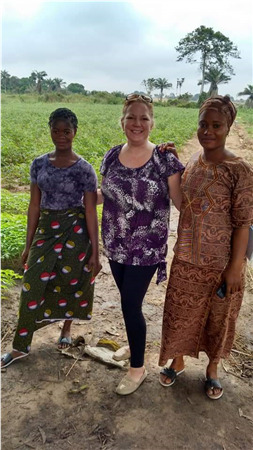
Later, at the African Development Bank (2016–2018), I worked on gender-responsive budgeting and women’s economic empowerment across multiple African nations, including Guinea-Bissau. Here, Rotary’s lessons in collaboration and partnership came alive. Just as Rotary connects diverse professionals for shared goals, I saw how financial institutions could empower women by mainstreaming gender equality into investment policies. This work linked macro-level financing with grassroots realities, proving that systemic change is possible when values of equity and inclusion are prioritized.
At the Caribbean Development Bank, I advanced gender-responsive finance and designed training to integrate gender equality and social inclusion into infrastructure and climate initiatives. Most recently, in Mozambique with GAPI Development Financial Institution, I developed gender policies, strategies, and monitoring frameworks to ensure women’s economic empowerment was not an afterthought but a cornerstone of institutional practice. Each of these roles echoed the Rotary values of leadership, integrity, and global fellowship.
Rotary’s ripple effect has also extended into my home province of British Columbia, where I now lead equity, diversity, inclusion, accessibility and anti-racism programs for the Ministry of Children and Family Development. Whether fostering inclusive workplaces, guiding data standards for equity analysis, or supporting 2SLGBTQIA+ communities, I see my Rotary journey as the through-line. Rotary planted the seed of hope and belief that global citizenship matters—and that each initiative, no matter how small, contributes to waves of transformation.
From a Rotary youth exchange in Brazil to gender policy influence in Africa and the Caribbean, the ripple effect of Rotary continues to expand through my professional and personal life. It demonstrates how Rotary empowers individuals to carry forward its vision—creating hope in the world, one ripple at a time.